christmas recap [part 1]

i know it's a bit late to be christmas blogging, but i couldn't resist recapping the festivities and our lovely visit home.

[a modified advent calendar for steve-25 small gifts/notes/stick figure drawings/coupons. i had a lot of fun wrapping these and steve had a lot of fun opening them. it made december go by really quickly too.]

  [our south african pre-christmas tree]


[photo cupcakes, because, well, i love photos, to celebrate dad's 68th birthday]

[emelia was really stoked to pick out the byrnes families second ever
R E A L christmas tree]

  [emelia decorated the bottom, beautifully i might add]

 [and steve and i heped with the top. note: if i were tagging this photo i would probably give
props to thomas kinkade for his painting]

[...and emelia thought her sparkly pony would make a great ornament. we agreed]

[emelia wanted "long rainbow hair" and joe made this a reality]

**more photos soon**

Read more...

l’union fait la force.

I read this excerpt from an article about the earthquake in Haiti and felt that it was an important one to pass along.

Haiti, we love you.
Disasters like this one are especially devastating when they strike places that are already struggling  to provide the most basic of services for its population. With weak government and private sector institutions, and with uncertain security conditions, Haiti is the poorest, least developed country in the Western Hemisphere, and the majority of Haitians live in poverty. The sheer scale of poverty in the country means that the government has limited capacity to meet even the simplest needs of its people, let alone address a disaster of this magnitude. Haiti’s lack of development—which translates into a lack of government capacity for emergency preparedness—magnifies the impact of this tragedy. In addition to creating a very real and immediate humanitarian tragedy, this earthquake and the struggle to navigate its aftermath will be an enormous setback to the hard-won gains that Haiti has achieved in recent years in securing a more stable environment and fighting poverty.

While disaster preparedness and long-term development initiatives may seem to fall at opposite ends of the development spectrum, they are in fact profoundly connected. Disaster preparedness plays a crucial role in the fight against poverty. Without it, gains against poverty are physically erased, and post-disaster countries face insurmountable challenges in getting back on track to meet their development goals. In Haiti, once the immediate disaster is addressed, it will be an uphill battle to return to its former state of development, let alone make further gains.


This situation demonstrates how investments in long-term development, especially in fragile and disaster-prone states like Haiti, could help countries deal with disasters, and also keep them on track to develop.
In spite of this disaster, a great aspect of Haitian history tells us the Haitian people are resilient and determined to better their lives. I am confident that with the help of strong partners around the world, Haiti will rise from its rubble and Haitians will live their motto: L’union fait la force (Unity is strength).

Read more...

the prince of egypt.

well, since i have been strongly advised not to post anything on the internet about what we are doing here in Egypt for the protection of all people everywhere (well, here) i have decided to make today's post a little bit less informational/heart striring (if this blog ever really is that) and a little bit more like an entry from the journal of a girl in love (note: this is the type of entry that i usually resort to in situations like this one. it's a big part of the journey, right?) this girl is me and the guy is the one and only stephan schallert. because of him, my life is a dream. there is no one i'd rather travel the world with, share hearts with, no one else who knows how to diffuse my heart with a single glance and i think the only person who still thinks i'm beautiful even when my face has been bit by a scorpian, stung by a bee etc. (yeah, it happens).


Read more...

off to egypt.

Read more...

filters for families.

Click the photo for a great opportunity to give clean water to a family in Africa this Christmas.

Read more...

a fish in a story about an ocean.

Over two months spent in South Africa and nearly reaching that date that used to seem far off which has snuck up and become “3 more weeks”. Three more weeks until I drive to the airport, stand in lines, move through security with hundreds of others in the quiet chaos of removing our shoes, belts, coats, scarves, convince guards we aren’t smuggling bombs, wait to board, wait for takeoff and then stare out a tiny window as if to say goodbye to yet another place I’ve fallen in love with. About the time the stewardess rolls down the aisle with the drink cart I’ll have entered into reflection about what was just happened in my life and I will probably take out my journal and begin writing frantically, trying to capture what I am feeling right then and there, wondering as I write if I’ve done any good and why I can’t be everywhere in the world all at once. Then a steady, holy whisper will interrupt my thoughts and remind me that there is a bigger story that I am a part of and that whatever experience I have just had is a fish in a story about an ocean. I will order a cranberry juice and try to convince Steve to order a ginger ale and propose that we share our drinks, combine them and make spritzers. He will probably agree and as we concoct delicious fizzy goodness I will look at him and know that the gears in his head are turning and that the same tension that is escalating in my heart is shared in his. He will take my hand and we’ll recline our seat backs a little bit, breath deeply and silently prepare our hearts for the next part of the journey.

By that point I’ll probably have closed my eyes, put my head back against the pillows I’ve collected from the empty seats around me and be on to thinking about how romantic Africa is; it’s tall mountains named after the wild game that roam it’s valleys, the breathtaking pinks, purples and reds in its skies at dusk, the energy you feel as you pass by a group of men singing and dancing on the sidewalk or the respect you feel when you see a woman balancing groceries on her head, a baby strapped to her back, knowing she has probably walked for miles and she probably has miles more to go. Yes, there is an inexplicable vibrance here that seems to be encouraged by the steady sound of tides rolling in from the Indian and the Atlantic as if to say over and over “life is here, hope is here.” I don’t think I am the only one who romanticizes Africa. If you live in the west it is generally portrayed as a place where HIV and AIDS victims suffer hopelessly, where swollen bellied babies with big, sad eyes stand in line for rations at feeding schemes, infomercials about why we should donate 25 cents a day for eighteen months so that a family can have clean water and an excuse for why American kids have to finish their dinner.

Ironically I’ll finish the last part of that thought just in time to refuse a scary meal in a tin tray. Steve will dig in, tell me it’s not as bad as it looks and put all of the tomatoes from his mini-side-salad in his empty coffee cup and hand them to me. Such a thoughtful husband. I’ll eat my lycopene and my mind will go back to Africa. It’s not to say that the generalizations about Africa aren’t true, yes, your 25 cents a day will probably change someone’s life forever. But the thoughts that will be swirling in my brain will be of a life I don’t quite understand. About why I was born in a place where most of the swollen bellies are caused by overabundance and not malnutrition. About if I am convincing myself that I am actually doing some good in the world. I’ll search my brain and try to get to the core of what is causing the pangs in my chest. I’ll take out my headphones and listen to some music to slow my heart down. I’ll fall asleep and wake up 11 songs later. I’ll know that the generalizations about Africa only become scary and wrong when we begin to think in the context of ourselves as the fixers of the world and the hungry people with the dark sad eyes as the ones who need to be fixed. When we take on the humble mindset of servants to all, we realize that there are infinite connections between me and you and the kids whose faces flash for 30 seconds on the screens in our living rooms. I need to be redeemed just as much as him, her and you. I’ll take out my journal again and my favorite black pen but this time I won’t write frantically. I will write a three word prayer, “peace.be.still”. I will exhale deeply and open my window to realize I am flying high above the clouds.

Read more...

purple sheep.

{note: this is not the actual stained glass window that I refer to below}

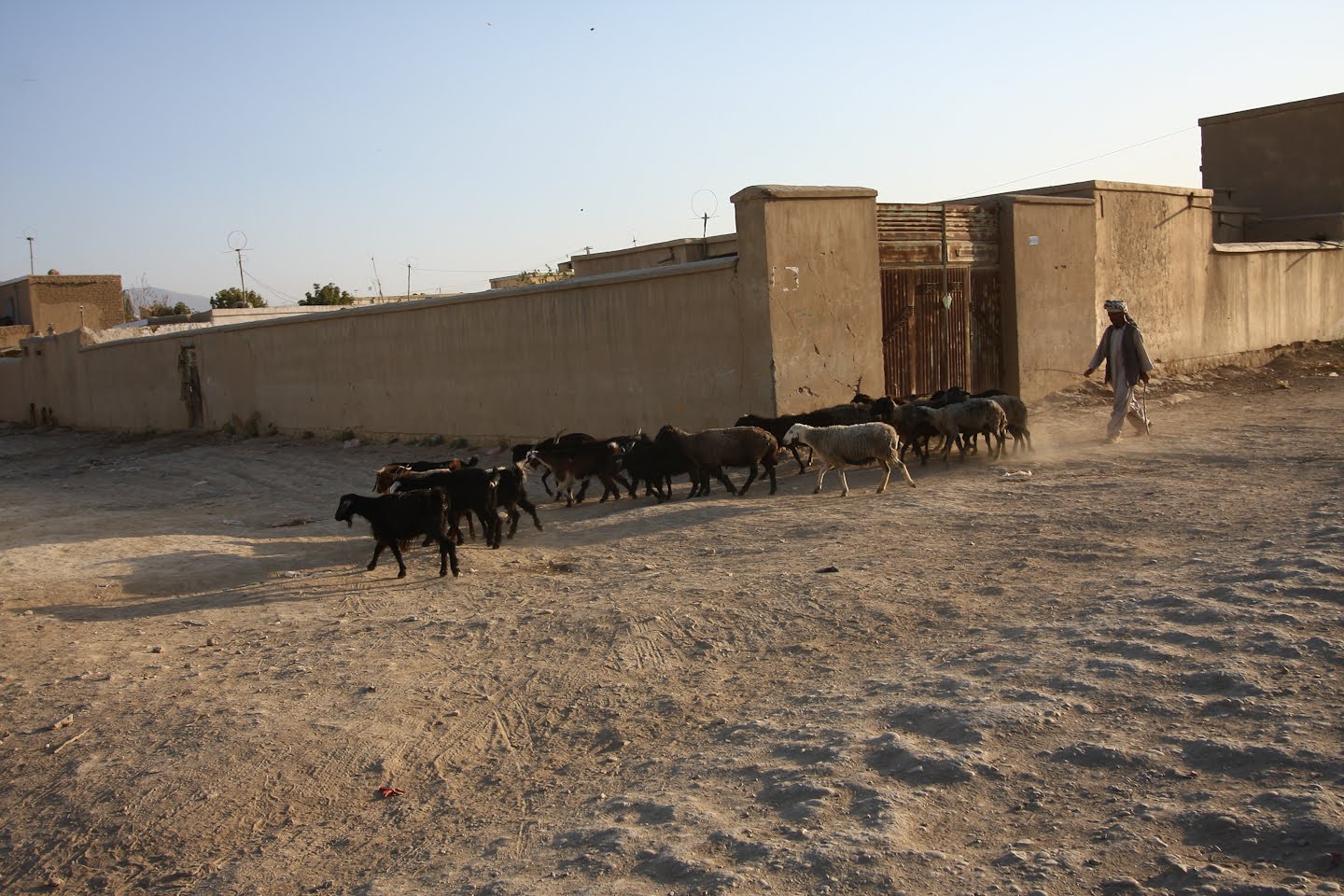
I was recently in a church where there was a large stained glass window, front and center, depicting Jesus as "The Good Shepherd", halo around his head, with pink and purple sheep surrounding him. He held the smallest, least colorful sheep in the palm of his hand and a glowing staff in the other. When I first saw it I smiled, admiring the artist for their creativity, but the longer I sat there staring at it (it was smack dab right in the front of the church, so I really couldn't help it) I couldn't help but ponder how I envision "The Good Shepherd" when I pray, "...I shall not want..."Of course I have a limited understanding of what it means for Jesus Christ to shepherd me, framed within the context of sheep grazing within fenced areas on farms. Jesus was talking to a group of men who knew sheep (John 10). I imagine these men have a similar thought pattern as the shepherds that Steve and I met in Afghanistan last year when it comes to sheep. The sheep that I envision aren't the cute and cuddly stuffed toys (unrelated sidenote: all of Katie's toy sheep, yes there were more than one, were named "Joey") that my sister carried around as a kid. As creative as I am, I am way too much of a realist (I refused to watch cartoons as a kid) to imagine a glorious, glowing Jesus snuggling pink and purple sheep. The sheep that I envision are the kind that roam aimlessly, that eat garbage out of gutters unless directed to the luscious patch of green meadow and peaceful stream beside it.

We were driving on our way back into town from a remote village where we had just distributed food during a drought. We were WAY out there and hadn't seen any sign of life for hours. Then, in the dusty distance, 3 figures appeared. As we got closer we could make out hundreds of sheep, a few donkeys and three men. We stopped to meet them and offer them the last of the oil, sugar and flour that we had left over from the food distribution. They were grateful, thanked us and told us that they had to be on their way. The sheep needed to be tended and guided. The shepherds walked away from us and we watched as their sheep followed.

I can't speak for the stained glass artist, but for me this is a beautiful example of "The Good Shepherd" faithfully guiding his sheep through right paths in the desert, no end in sight, but still they lead their sheep onward.

The LORD is my shepherd;
I have all that I need.
He lets me rest in green meadows;
he leads me beside peaceful streams.
He renews my strength.
He guides me along right paths,
bringing honor to his name.
Even when I walk
through the darkest valley,
I will not be afraid,
for you are close beside me.
Your rod and your staff
protect and comfort me.
You prepare a feast for me
in the presence of my enemies.
You honor me by anointing my head with oil.
My cup overflows with blessings.
Surely your goodness and unfailing love will pursue me
all the days of my life,
and I will live in the house of the LORD
forever.
Psalm 23

Read more...

in the know.

Being in a country with over 12 million aids orphans, our group became quickly aware of how little we know about HIV and AIDS. This is partly due to the fact that there are misconceptions about the illness in the United States, so it becomes a hush hush problem that "happens in Africa and to homosexuals" and is portrayed on popular television shows as a deadly disease that you can contract when someone who is HIV positive so much as breathes on you. In an attempt to shed some light on this illness, I am passing on some (paraphrased) information from my dear friend, Laura, who is a psychologist, counselor, lecturer, mother and runs Voice for the Voiceless with her husband here in Cape Town.


General Facts about HIV

Originally called G.R.I.D (gay related immune-deficiency)

Over 20 years ago Acquired Immune Deficiency Syndrome (AIDS) was first documented in the United States

More than 15 years ago Human Immunodeficiency Virus (HIV) was linked to and identified as causing AIDS

Since then HIV/AIDS cases have been documented all over the world

First labeled a sexually related illness but later found out that hemophiliacs were also contracting the illness. Soon after it was realized that prostitutes and children were also at risk and than eventually realized that all humans are susceptible.

There are two different types of HIV
HIV 1 -associated with infections in Central East and Southern Africa, North and South America and the rest of the world
HIV 2 -West Africa (acts more slowly)
Often strands cross and people acquire a double infection (1 and 2) which causes the virus to act much more quickly.

HIV first Identified
-Acquired Immunity deficiency syndrome first described in America in 1981.
-Number of men developed a rare pneumonia cause by a parasite
September 1983 scientists in France discovered the human immune-deficiency virus (HIV) to be the cause of this new disease called AIDS
In Central Africa health care workers were discovering a new disease called “slims disease” also due to immune deficiency and it was present in heterosexually orientated people.

Earliest Instances of HIV:
-1959 plasma sample taken from an adult male living in DRC
-HIV found in tissue samples from an American teenaged who died in St. Louis in 1969
-HIV found in tissue samples from a Norwegian sailor who died around 1976

Origins of HIV:
Most accepted explanations:
HIV crossed the species barrier from primates to humans at some time during the 20th century

HIV is related to a virus called SIV (simian immunodeficiency) found in chimpanzees and African green monkeys.

The virus probably crossed over when contaminated animal blood entered open lesions or open cuts on the hands of humans who were butchering of SIV infected animals for food.

While initially the spread of HIV was probably limited to isolated communities various factors such as migration, improved transportation, networks, socioeconomic instability, multiple sexual partners, injecting drug use

Contributing factors to the fast travel of HIV- Complex processes
-National and international travel, especially international travel in the Gay community
-In Africa the virus would have spread along truck routes between towns and within the continent itself. Also liberation wars led to mass rape and pillaging, therefore the soldiers already infected with HIV positive spread HIV rapidly.
-Patient “0”
-Blood industry boomed-as blood transfusions became routine parts of medical practice. The demand for blood began to develop rapidly. In countries such as the USA people were paid for their blood often attracting the most desperate for cash. IV drug users. Doctors were unaware of how easily HIV could be spread and remained unscreened. In the late 1960’s hemophiliacs began to manifest symptoms of HIV
Drug Use-in the 1970’s there was an increase in the availability of heroin following the Vietnam War and other conflicts and helped to stimulate a growth in the use of drugs

Global realities
-More than 25 million people have died of AIDS since 1981
-Africa has m12 million aids orphans
-By the end of 2005 women account for 48% of all adults living with HIV worldwide and 59% in sub Saharan Africa
-15-24 year old kids account for half of all new HIV infections worldwide around 6,000 become infected with HIV every day.
-In developing and transitional countries 6.8 million people are in immediate need of life saving AIDS drugs, of these only 1.65 million are receiving these drugs

South Africans spend more time at funerals that they do having their hair cut, shopping or having Braais.

Read more...

a blog for steve.

dear steven, please feel better soon. love, wife.

Read more...

ce la vie...

so (and i can't believe that i am starting this note with "so" because i always convince steve that it's grammatically incorrect, even for blogging), sometimes when you find yourself far from home you need to celebrate the "small things" in life in order to stay sane. so, two days ago steve and i celebrated our "two years ago since the steve and diane saga started". we tried to go to a funky, fun restaurant and ended up at one that reminded us a lot of Monday nights with Grandpa Chinworth at the Golfer's Club. it was such a great night. we got to talking and realized that we don't often S T O P and reflect on where we are, where we have been and where we are going. so, i got out my mini-purse-sized-notebook (because i need to write things down) and started to make a list (because i need to make lists). the list is called, "two years from when the text went out" and it goes as follows:

1. the text went out.
2. fell in love.
3. laguna beach (for the record, this is not pertaining to the actual laguna beach, but some drama that we likened to the hit, ridiculously overdramatic TV show, laguna beach")
4. moved to an island in the pacific.
5. got engaged on said island.
6. got married on said island.
7. had an amazing wedding for realllly cheap. (thanks God, family and friends).
8. Kauai Honeymoon.
8.5. India.
9. Afghanistan Honeymoon. (got weird diseases, sat on a soviet tank, got worms, got bombed, fell in love with a beautiful nation, etc)
10. South Africa.
11. Walked around Prague to decompress. Also, to spend some time alone for the first time in our marriage.
12. Moved "Down South, USA" (love to Jon + MC)
13. Back to that one Island.
14. Made a commitment (PhotogenX.net)
15. Went to Panama.
16. Published our first book to advocate orphans rights in Panama.
17. Quick visit to the states for some home cookin' (thanks, Moms.)
18. Back to South Africa.


photo | ryanp.

and so it goes.
we have a really beautiful life.

Read more...

a national search for human worth...

http://www.youtube.com/watch?v=D4323bRWrj0

Read more...

Dear Panama

{We gave the kids mini cameras so that they could "photograph" us}
Our team is working alongside Heart's Cry Ministry, run by Matt & Misty Hedspeth and their friend Ari Herrera, to help create efficiencies for Orphans in Panama. There are over 50,000 institutionalized children in Panama and an adoption system that is almost nonexistent. There are nine known foster care families in the entire country. Matt and Misty (Misty is a former family rights lawyer) have submitted a proposal for implementing changes to adoption and orphan care systems to the Panamanian Government and JUST last week, after two years of them working tirelessly, the proposal was accepted!!! Thank you so much to those of you who have been keeping up to date with our outreach here in Panama and for your prayers on the day that the proposal was accepted. Our team is putting together a full fledged publication to spread awareness about the current law, the proposal and conditions in orphanages in Panama. The book will be distributed to the government and the public of Panama and hopefully will be sold in the States to help support Heart's Cry Ministry. We have been working in several different orphanages during our time here to be connected with the people at the heart of the issue; the orphans themselves.
{Storyboards for the publication, "Dear Panama; A Letter from Your Children}
Below is a journal entry from a few weeks ago when our team spent several nights at an orphanage about two hours from our "home base" in Gamboa, Panama. The twenty three 3-5 year olds who there are staying at the house while their usual facility in Panama City is being renovated.

27. July. 2009 early AM
In a beautiful house on top of a volcano in El Valle I am once again amazed by my God made so evident in his creation all around me. The sun rises and as our team slowly wakes from slumber in the loft we see the sky turn from dark blue to pink to blue again. SO much beauty. Below us twenty three 3 to 5 year old's sleep side by side in their "beds" on the floor. As they wake from sleep and inundate us with a chorus of "Buenos Dias!!!" they steal our hearts. They are precious. They are innocent. They are abandoned. We played games and sang songs and ran around the beautiful green yard, picking limes from trees and scooping up mangoes that have fallen from their branches. Towards dinner time, Sia, Ana and Maria made "birthday cakes" , with twigs for candles, in the dirt in the driveway. Over and over we sang "Cumpleanos Feliz" to each other and took turns "blowing out" the twig candles. My heart exploded with J O Y as Sia sang to me over and over and over. Later I found out that it actually was Sia's 3rd birthday. She celebrated it with nothing more than a cheery disposition and a birthday cake in the dirt. At dinner time all the kids sat around their giant picnic table and sang a song about being quiet at dinner time. When the song was over they all gave themselves a hug and recited together, "we are important people who are loved very much". I teared up as I translated this to my team (I understand poquito espanol). When our team was praying together later that night I cried as I prayed to God, please bring people into these children's lives who will hug them and remind them that they ARE important people. That they ARE loved. I believe our team is here for a crucial purpose and that we can communicate something so profound of the character of God. I believe our photography can empower them and that change can come through telling their stories. But there is only so.much.we.can.do in just a few short days. With every encounter with these lonely babies we are made continually aware of how important the work that Matt, Misty and Ari are doing with their ministry here, Heart's Cry. They are making
H O P E an option for these precious little lives. Jesus, be here. Amen.


{Happy Birthday to YOU!}
"When we commune with one another we respect the image of God in others to protect it in ourselves. Communing together reminds us of our own humanity." - Rob Bell

**The names of the children in this story have been changed to protect their identities**

Read more...

Ngobu Madimiga!


{Overlooking the 15 acres that a Ngobe chief donated to Youth with a Mission}
Hola from Panama! I apologize for my lack of updates lately, but it has been quite hard to communicate without a computer. As you know, the-Diane-and-Steve-Schallert family laptop (along with a backpack full of various other things) was stolen just over a month ago on our first night in Panama. Because of the generous response of our wonderful family and friends we have just ordered a new one and will be getting it in August when we visit the United States on our way to South Africa! I am overwhelmed by God's faithfulness to us and the way he uses his people to practically love and help one another.

Our team is blessed to have the opportunity to work in many different parts of Panama. We stayed with an indigenous tribe, The Ngobe (sounds like No-Bay) for 9 days. In the region that we stayed for the majority of the time we were the first foreigners ever to visit. The Ngobe are a beautiful people who lead simple lives and cling to their indigenous culture. They are agriculturists and are entirely self-sustained. Their huts are spread apar
t from each other as they live off of their farm land. Their culture is conservative and very peaceful. Although Catholicism and Christianity are practiced amongst them, the most prevalent practice is of the occult, Mamatata. In attempt to develop th
eir community, the Panamanian government has set up a school system for the Ngobe. All children are required to attend school, despite the school house being a two hour hike from some of the students’ homes. They are not permitted to wear their indigenous dresses and they are forced to speak only Spanish instead of their native tongue.

{Our catholic church "casa" in Cerra Flores}
[Journal Entry - Cerra Flores, Panama: Ngobe]
6 hours on a bus `+ 30 minute taxi ride + 2 hour ride up a mountain, 15 friends in the back of a pickup truck through the most beautiful landscape any of us had ever seen. Another truck followed us with about 15 more. Above the clouds we kept driving...Up.Up.Up. Passing by serious women in long, colorful dresses and children who ran after our truck, waving and than shrinking back coyly when we would wave back. We stop suddenly and realize we have arrived at a simple home where a man named Rafael, his wife and their 5 children live. Rafael is an indigenous Ngobe Pastor who travels around and starts churches. As we greet his family from afar we have no idea what is in store for us in this unfamiliar place. As Pastor Rafael and his family exchange some words with our translators, we realize we have not yet reached our final destination. We negotiate with the drivers of our 4 x 4's to continue taking us higher into the clouds. Finally they agree. More mountains. More clouds. The cool air blowing our hair in its breeze. We stop and the drivers begin to unload our bags from the metal bars above our heads in the back of the pickup trucks. We are at our destination, Cerra Flores. We are led by villagers to a humble catholic church. 14 people spread their sleeping bags on the concrete floors and hang their mosquito nets from the ceilings. The married couples (Me and Steve, Ryan and Jeanette) pitch tents on a concrete slab outside of the church. It has a makeshift roof over it (in case of rain...we are in the rainforest). Night falls quickly and fireflies surround us as a full moon moves out from behind foggy cover. As we turn in for the night we are overwhelmed by the realization of the presence of God, in inescapability of who he is. We are here. Now. Ce
 la Vie. At the end of a long day of visiting homes, our group waited, the rain falling hard outside of our concrete church home, for those we had invited to our gathering. The time that the meeting was scheduled to start came and went. About an hour and a half after we had planned to start, we began to get discouraged that no one we had met that day would come. Then, slowly men and women started to come in, soaking wet from walking a distance to come, their small children trickling in behind them and their babies in bags strapped to their heads (yes, they put their infants in straw bags and wear them on their heads. Steve has his hear
t set on carrying our children this way in the future). We talked (triple translation- English to Spanish to Ngobe) about the importance of preserving culture. We spoke about how photography is such a powerful story telling tool and that we wanted to tell the story of the Ngobe with the rest of Panama and the world. As we explained how communicating the strengt
h of their culture to the government and to their fellow Panamanians, their view on photography shifted from a mindset that says “photography steals ones soul” to “photography brings dignity and life!” We shared about our cultures and how we feel God can be glorified through our languages and traditions, a concept that is foreign to a people who have been ingrained to believe that they must sing from a Spanish hymnal in order to glorify God. As we celebrated the Ngobe culture with t
hem, one of the village chiefs spoke up. He was so moved during the meeting that he donated 2 hectors (about 15 acres) of land in the Ngobe capitol of Tugri to Youth With a Mission to start a cultural preservation center, a medical center and a discipleship program there. Our team was elated and we knew then that we needed to go to Tugri where this center will eventually be set up. Although Tugri is the “capitol”, it is a much more remote village than Cerra Flores. We hiked 6 hours up and down mountains, sometimes in the mud, forging rivers, praying that the daily downpour of rain would hold off, and finally arrived in Tugri. As soon as 
we stepped onto Tugri land, the sky opened and the rain came down. Hard. We felt really felt blessed by the timing of it all. A group of 6 musicians from Mexico had traveled with us and planned to do a song writing workshop with the people. The workshop would encourage them to write songs that glorified God using the styles and traditions of their indigenous music. The workshop went really well and we believe it is just the start of something so powerful amongst the Ngobe. While we were there we were able to go to the place, att the highest point of the Ngobe land, overlooking the entire village where the YWAM Cultural Preservation Center
 will be. We prayed over the land, that it would bear much fruit and be a place of HOPE and PEACE for the Ngobe.
Straight from Tugri (the hike back took less time, we were proud of ourselves ; ) we met up with a medical team from Conneticut who set up a makeshift clinic in one of the government schools in another Ngobe province, Cameron Arriba, about two hours away from Cerra Flores. 

For three days our team worked alongside them to help organize the patient flow, assist in the Pharmacy, hold babies, cook meals for the medical workers, take photos, pray, love, be. It was quite different in Cameron than in the more conservative Tugri and I think we were all experiencing a bit of a culture shock (plus we were simply exhausted) but it was really incredible to assist a medical team of about 20 (Doctors, Nurses, a Dentist and a Pharmacist) see 2,000 patients in three days!

We found a beautiful gem within the Ngobe…in their culture, in the landscape all around us. Surely they carry a special part of his character within them. Surely they are his treasure. A treasure whose stories we are so excited to share with the world.


{Hope for the Ngobe}
We arrived back in Panama City and immediately began to prepare for the "Una Voz" (one voice) conference that was held the very next day (yes, we run a tight schedule). Over 50 different artists came together to act as ONE VOICE for JUSTICE. There was dancing, music, indigenous crafts, international cuisine, painting, scultping, multi-media presentations and our group had a photo gallery. Susi Childers,co-founder of PhotogenX, along with a few others from our group, shared about the Orphans Crisis and Human Trafficking here in Panama. At the end of the night we launched the 30 Days of Prayer for the Voiceless Prayer Booklet in Spanish for the first time! We really believe that the festival was the start of stirring people to action against injustice here in Panama. Please join with us in praying that JUSTICE and COMPASSION would flood this nation.

Ngobu Madimiga!

(God Bless You! in Ngobe).

Read more...

Shakin It Up [Gamboa, Panama]

The journey has begun and we have found ourselves in a quiet town in Panama,overlooking the canal, mid way between the jungle and the city. Our entire group is staying in a small church where Pastor Wilbur and his wife Ann have opened their doors and their hearts to us. www.gamboaunion.com Our time here thus far has been full of opportunity to get involved with projects that will have a lasting impact in Panama. What more could we ask for

150 Pastors and ministry leaders gathered at the Voice for the Voiceless conference here in Panama last week. Susi, co founder of PhotogenX, came to speak at the conference and will be spending the next month here with our team. As she shared her heart, there was electricity in the air. You could sense it. Hearts stirring within chests, beating loudly to connect with Gods own. Church leaders recognizing a renewed call to ACTION. God is truly shaking things up in Panama as his children decide to engage in his work. The very next night the EARTH shook! A 6.0 earthquake about 60 miles away woke us up at 2am. I had started to feel sick that day and was so delerious that when Steve told me that there was an earthquake, I put the entire sheet over my face [not unusual for me], assured him that it was just a train, and shifted to get comfortable on the shaking ground where we were sleeping.

I am an acheiver. I make to do lists for what to make to do lists for. I keep a running tally in my head of all the practical things I do in one day, and when night falls, the tally is wiped clean only to be started up again in the morning. I multi task. SO, at the end of the day when its time to lay my weary head to rest, I can sleep easy knowing that my checklists are filled with checks and that tomorrow is another day...UNLESS I am sick. In which case I have to suffer the worst imaginable punishment...I have to stay in bed all day long feeling miserable and like I can accomplish nothing. This proves to be particularly frustrating when the things on my to do lists are:
1. hang out with kids at orphanges.
2. help put an end to human trafficking.
3. trek through the mountains of Panama to spend 9 days with the most marginalized people group in the country.
and stuff like that. All of that said to give you an update on my health. There is some sort of flu [not the swine flu, mom] that has been going around our community and just when I thought I had enough vitamin C, Airborne and TLC in my system to ward it off, it hit me HARD. Steve deserves a trophey and the giant chocolate brownie vanilla ice cream sundae that he keeps talking about for nursing me back to health ...again.

I am learning to embrace my weakness before God and to live in utter vulnerability and dependence on him, in health and in my frailest moments. There is so much hope in knowing that his strength is made perfect in my weakness. I am resting and am hoping to be better in the morning to go to the Ngobe village.

Read more...

sanibonani.


the more that i expand my world-view and study injustices around the globe the more that i am confronted with the inescapable reality that these "issues" are more than facts on a piece of paper. more than statistics. more than unfamiliar faces. more than far away issues in far away places. 
they are 
true stories.
real lives.
living
breathing
 S O U L S.

at times it gets overwhelming to take it all in. it should be overwhelming, because it is too big for humans alone. a few days ago in a morning prayer meeting the speaker had us turn to the person beside us and stare into their eyes. initially this was extremely awkward, but as we got over ourselves and began to relax an unvarnished truth cut to my core. 
there is a God who SEES US
 and doesn't turn away.

sanibonani. 
literally translated this african greeting means, "i see you". sometimes merely recognizing one's needs is all it takes to spark hope in their life. let's take time to truly SEE one another. once our eyes are open we have a responsibility to take care of one another, to refuse to ignore the disparities of society and instead address them in whatever capacity we can.

Read more...
© 2010 unless otherwise stated all photos are copyright diane schallert and may not be used without permission. thanks.

  © Blogger template Shush by Ourblogtemplates.com 2009

Back to TOP